
Connect Clinical Services | Houston, TX
Psychotherapy for Anxiety in Houston: Which Approach Works Best for Your Anxiety?
By Guy Bender, LPC, Clinical Director | Published April 2026 | About the Author
Not all anxiety is the same, and not all therapy approaches work equally well for every type of anxiety. The right treatment depends on what is driving your specific anxiety: is it rooted in unresolved trauma, a sensitized nervous system, learned thought patterns, or dysregulated brainwave activity? This guide compares the major psychotherapy approaches for anxiety available in Houston so you can make an informed decision.
Understanding What Drives Your Anxiety
Anxiety is not a single condition. It is a category that includes fundamentally different presentations with different underlying drivers:
Generalized Anxiety Disorder (GAD): Chronic, pervasive worry about multiple areas of life. Often involves a sensitized nervous system that defaults to threat mode. The worry feels uncontrollable and shifts from topic to topic.
Trauma-rooted anxiety: Anxiety that developed after or in response to traumatic experiences. The nervous system learned that the world is dangerous and maintains chronic hypervigilance. This type often co-occurs with PTSD symptoms even when the person does not meet full PTSD criteria.
Social anxiety: Intense fear of social situations driven by beliefs about judgment, rejection, or inadequacy. Often rooted in early relational experiences or developmental wounds.
Performance anxiety: Activation triggered by evaluation situations: presentations, exams, athletic competition, creative performance. The nervous system associates being watched or judged with threat.
Health anxiety: Persistent preoccupation with having or developing a serious illness. Body sensations are misinterpreted as signs of disease, creating a cycle of monitoring, alarm, and reassurance-seeking.
The right therapy approach depends on which of these presentations, or which combination, is driving your experience.
Comparing Therapy Approaches for Anxiety
Cognitive Behavioral Therapy (CBT): The most-researched psychotherapy for anxiety. CBT identifies and challenges the thought patterns that maintain anxiety (catastrophizing, overestimation of threat, intolerance of uncertainty) and uses behavioral experiments and gradual exposure to build new, less anxious responses. CBT is effective for GAD, social anxiety, and health anxiety. It works at the cognitive level, teaching the thinking brain to evaluate threats more accurately.
EMDR Therapy: Often used when anxiety is rooted in identifiable traumatic experiences or adverse life events. EMDR processes the memories that are keeping the nervous system in threat mode. When the root memories are resolved, the chronic hypervigilance decreases because the brain is no longer operating from unprocessed threat data. Particularly effective for trauma-rooted anxiety, performance anxiety with roots in early experiences, and anxiety that has not responded to CBT alone.
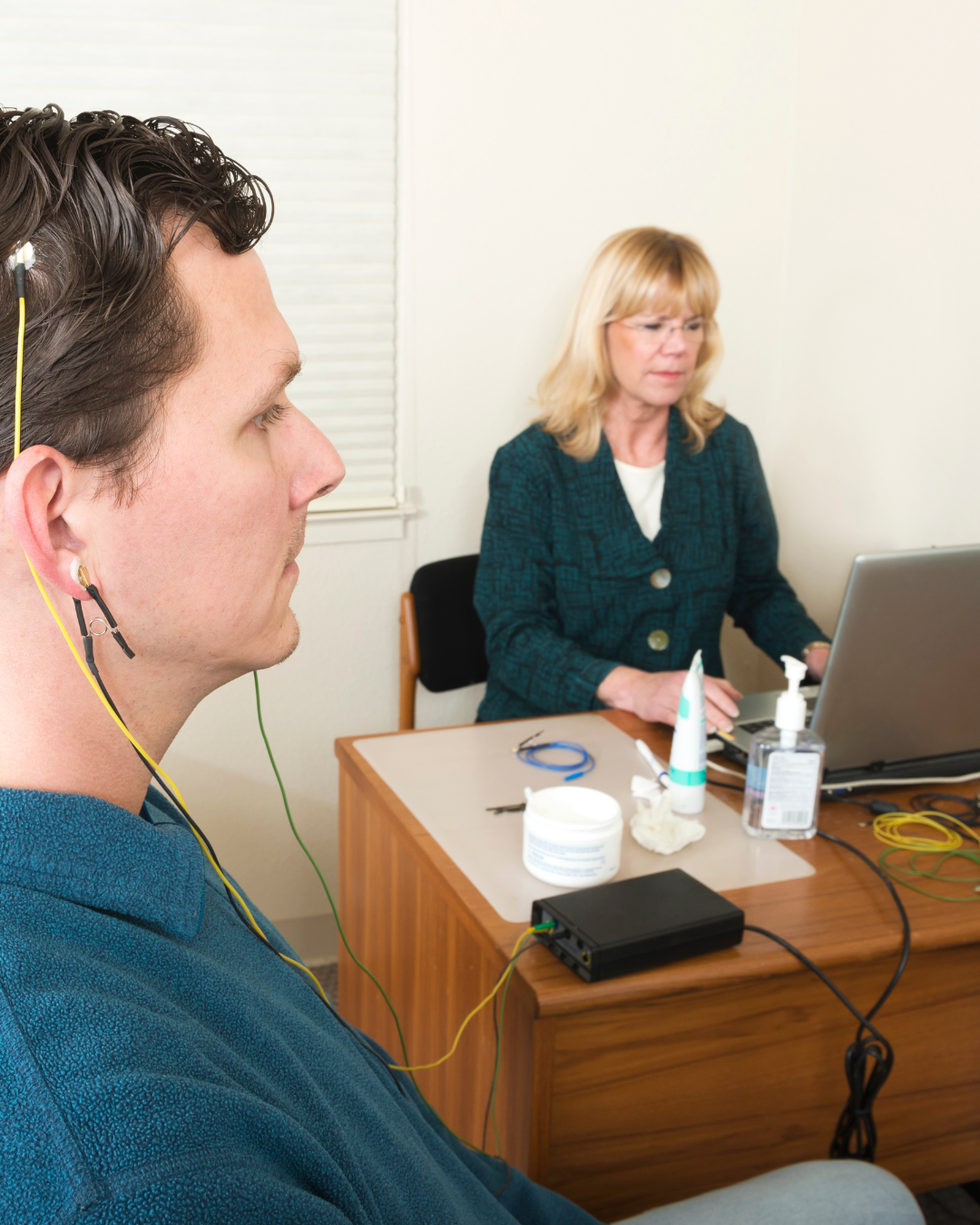
Neurofeedback: Addresses anxiety at the brainwave level. qEEG brain mapping reveals the specific electrical patterns associated with your anxiety (often excessive high-beta activity in frontal and temporal regions). Targeted training teaches the brain to produce calmer, more balanced activity. Neurofeedback is particularly effective for chronic, pervasive anxiety that seems to have no specific cognitive trigger, suggesting the dysregulation is primarily neurological rather than thought-based.
Somatic Experiencing: Works directly with the body’s stress responses. Anxiety lives in the body as much as the mind: the tight chest, the shallow breathing, the clenched jaw, the restless legs, the knot in the stomach. SE teaches the nervous system to discharge this activation and return to a regulated baseline. Especially effective for anxiety that is felt primarily as physical symptoms rather than worried thoughts.
Brainspotting: Accesses anxiety stored in the subcortical brain, below conscious awareness. Effective for anxiety that seems to come from nowhere, has no clear cognitive content, or persists despite understanding its irrationality. Also effective for performance anxiety in athletes, musicians, and professionals.
Matching the Approach to Your Anxiety Type
Based on clinical experience and research evidence, here is a general guide to matching therapy approaches to anxiety presentations. This is not a substitute for professional assessment, and many clients benefit from a combination of approaches:
If your anxiety is primarily worried thoughts and overthinking: Start with CBT. Add Neurofeedback if the anxiety persists at a physiological level despite cognitive improvement.
If your anxiety started after a traumatic event or during childhood: EMDR or Brainspotting should be primary, with Somatic Experiencing for body-based activation. The trauma must be addressed for the anxiety to resolve.
If your anxiety feels physical (chest tightness, breathing difficulty, stomach distress): Somatic Experiencing as primary, possibly with Neurofeedback for nervous system regulation.
If your anxiety is chronic and pervasive with no clear trigger: Neurofeedback to address the neurological pattern, combined with EMDR or Brainspotting to explore whether subcortical material is driving the activation.
If you have tried CBT and it helped your thinking but your body is still anxious: Add Somatic Experiencing and Neurofeedback. The cognitive brain has been updated but the nervous system has not.

Combining Approaches: Why It Matters for Anxiety
Most anxiety presentations involve multiple layers: cognitive patterns, stored traumatic material, body-based activation, and brainwave dysregulation. Treating only one layer, which is what happens when a practice offers only one modality, leaves the other layers untreated. This is often why people feel partially better but never fully resolved.
At Connect Clinical Services in Houston, we offer EMDR, Brainspotting, Somatic Experiencing, and neurofeedback at one practice. This means your treatment can address the cognitive, traumatic, somatic, and neurological dimensions of your anxiety simultaneously. As one layer resolves, the next becomes accessible. The result is more complete and lasting resolution than any single approach typically achieves.
Getting Started
If anxiety is affecting your sleep, relationships, work performance, or daily quality of life, you do not have to continue managing it alone. A professional assessment can identify what is driving your specific anxiety and match you with an approach that fits.
At Connect Clinical Services (8100 Washington Ave, Suite 170, Houston TX 77007), our care team offers a free consultation to talk through your situation and explain the options. We serve The Heights, Montrose, and Upper Kirby, River Oaks, West University, and Bellaire, Memorial, and all of Texas via telehealth. We are private-pay with superbills for out-of-network reimbursement. Visit our costs page for current rates.
Call (713) 564-5146 or request a consultation. You deserve to live without the constant weight of anxiety.



Schedule Your Free Consultation
Speak with our care team about your specific situation. No obligation. Our care team aims to call you back the same business day.
Or call: (713) 564-5146 • 8100 Washington Ave, Suite 170, Houston TX 77007
Ready to Take the Next Step?
Learn more about Anxiety Therapy in Houston at Connect Clinical Services, or call (713) 564-5146. Serving The Heights, River Oaks, Memorial, and all of Houston. Visit our FAQ page for more answers.
Frequently Asked Questions
What is the best therapy for anxiety?
Can EMDR help with anxiety?
Is Neurofeedback effective for anxiety?
Why hasn’t CBT worked for my anxiety?
How long does anxiety therapy take?
Can anxiety improve over the long term?
About the Author: Guy Bender, LPC, is the Clinical Director of Connect Clinical Services in Houston, TX. He specializes in trauma-focused therapy using EMDR, Brainspotting, Internal Family Systems, and Neurofeedback. 8100 Washington Ave, Suite 170, Houston TX 77007. (713) 564-5146.
Have More Questions?
Our care team offers a free 15-minute consultation to talk through which approach fits your situation.
Call directly: (713) 564-5146
EMDR Therapy Brainspotting Somatic Experiencing Neurofeedback Trauma Therapy PTSD Treatment Anxiety Therapy Depression Therapy Teen Therapy Couples Therapy Intensive Programs Group Therapy Our Costs Insurance FAQs Contact Us
Last reviewed April 2026 by Guy Bender, LPC, Clinical Director. Connect Clinical Services, 8100 Washington Ave, Suite 170, Houston TX 77007. (713) 564-5146.